The most famous Danish astronomer was Tycho Brahe, who
was born as a nobleman in 1546. As a teenager he went to the University of
Copenhagen to study civics, which was important for a young nobleman at that
time because the leaders of Denmark were a group of rich noblemen (many of whom
were related to Tycho). However, the young man was more interested in the stars,
and on a long study tour around Europe he met many of the leading astronomers of
his time. On this trip he also lost a part of his nose in a duel, and the rest
of his life he had to wear a silver-nose.
In 1572 a supernova in Cassiopeia appeared. Tycho saw it and wrote a book about
the new star; he proved that the star was as far away as the other stars, and
this revolutionary idea made him famous all over Europe (the common belief was,
that everything outside the orbit of the Moon was
made of the never-changing fifth element).
To prevent him from moving abroad, the king Frederik II, gave him the island of
Ven in Øresund, from where he observed the stars for 21 years. On Ven, Tycho
constructed a small castle, Uraniborg
(the castle of Urania), which had instruments under the roof, as well as an
observatory called
Stjerneborg (the castle of the Stars). He had a
residence in Copenhagen, and in 1589 he got permission to make an observatory at
the Watermill tower, one of the towers in the town wall.
His main interest was astrometry, and he invented many new and very accurate
instruments for the study of this. He got into trouble with the new king,
Christian IV, in 1597, and left Denmark. In 1599 he became court astronomer in
Prague, but in 1601 he died.
The most important among his posthumous
astronomical work was a star-table so accurate that it was first surpassed by
Flamsted in 1729, a new and better theory for the movement of the Moon and
accurate positions of the planet Mars, which made it possible for Kepler to find
his three famous laws.
One of Tychos cooperators, Christian Longomontanus, became the first professor
of astronomy at the University of Copenhagen, and in 1610 he received funds for
instruments and he probably constructed a small observatory at his home.
Astronomy became very important in the 17th century in Europe, mainly due to the
fact that the European countries began their rivalry to establish colonies. It
was necessary to navigate across the oceans and therefore many State
observatories were established; the first in 1632 in Leiden, Holland, and only
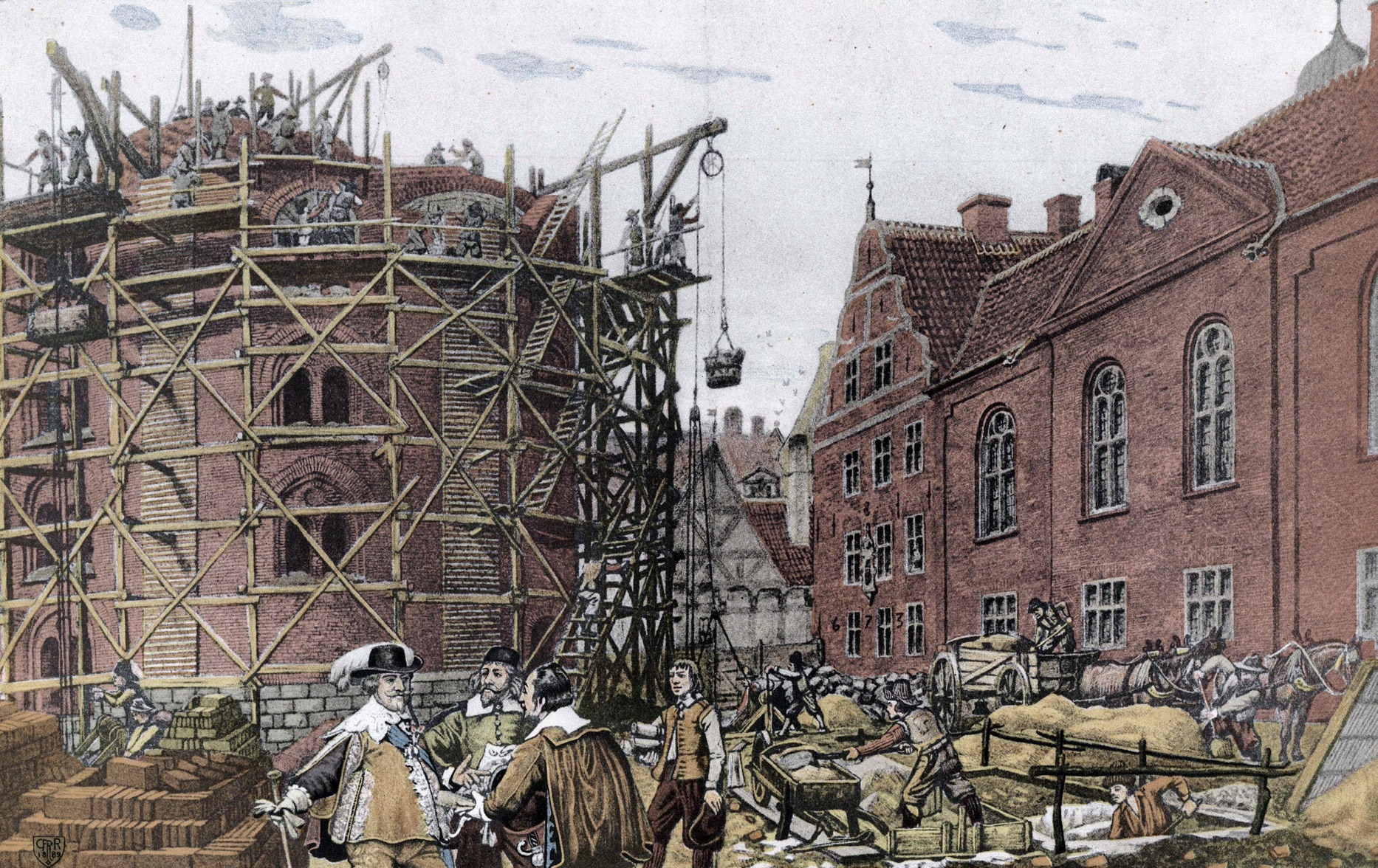
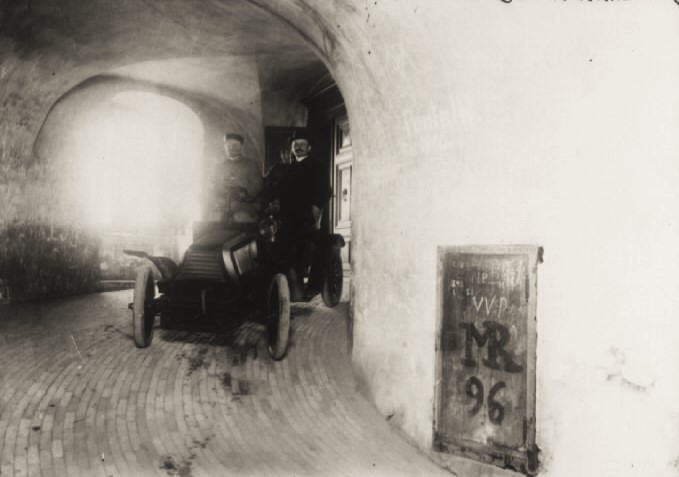
five years later the Round Tower Observatory (Its first name was "STELLÆBURGI
REGII HAUNIENSIS"). Longomontanus, who was already very old, was appointed the
first director of the observatory at the Round Tower. The original idea was that
there should be an observatory just like Stjerneborg at the top, which is why
the diameter of the Roundtower and the size of Stjerneborg are exactly the same.
The next important Danish astronomer was Ole Rømer, who
as a student came from Århus to Copenhagen in the mid-1660s, where he studied
astronomy. When the French astronomer Picard came to Denmark to determine the
correct position of Uraniborg, he appointed Rømer as his assistant. He followed
Picard back to Paris, and here he became a member of the Royal French Academy.
In Paris he made his famous and fundamental discovery of the limited
velocity of light by observing the delay of observed moon eclipses around
Jupiter compared with predictions.
After his return to Denmark in 1681, he became the director of the Round Tower
where he placed a
planetarium, and here, in Denmark, he introduced the
telescope and pendulum clock as pointing devices in astronomical
instruments. He later invented the
transitinstrument and the
meridian circle. His problems with temperature corrections led him to invent
a thermometer, where the scale was founded on two fixpoints (the freezing- and
boilingpoint of water), and therefore universal, an idea
Fahrenheit learned from him in 1708.
Rømer had a lot of other jobs which kept him away from astronomy. He was a
Supreme Court judge, a police master, chief of the fire brigade, made a new
measuring system (he founded every other unit on only one unit (a foot)), he
introduced the Gregorian calendar in Denmark, etc.
Among Rømers pupils, P. Horrebow tried to follow the tradition of his master.
Most of his findings were due to Rømer who published very little. Among other
things, he found the sun parallax, 9", an approximative solution to the Kepler
equation and the Horrebow-Talcott method for the determination of polar altitude.
He was succeeded by his son Christian, who observed the Venus passage in 1766
and discovered the periodicity of the sunpots.
The last important director of the Round Tower was T. Bugge, who bought modern instruments and published many papers. His most important work was, however, his leadership of the first precise mapping of Denmark, carried out under the auspices of The Royal Danish Scientific Society.
After Bugge, the scientific work declined. The instruments grew bigger and bigger, but the tower could not be enlarged, so in 1861 the observatory was moved to Øster Vold, where a new observatory was constructed on the remains of the Copenhagen fortification rampart. The well-known astronomer, H. L. D'Arrest, was elected to plan the new observatory. His main work was in spectroscopy, and he discovered, for the first time, the differences in the evolutionary state and spatial distribution of stars.
The next director of the Øster Vold Observatory was Thiele, a skilful mathematician who developed a new method of determining the orbit of doublestars. He founded the tradition for numerical computational mathematics, which has lasted up to modern times.
Under the direction of Ellis Strömgren, the computational work continued, and
during World War I the international central bureau for the exchange of news (comets,
novas etc.) was moved from Kiel to the
Øster Vold Observatory. And from 1922 until 1965 the central bureau under
the International Astronomical Union had its residence in Copenhagen.
Ellis Strömgren was succeeded by his son
Bengt. He made the pioneering discovery that hydrogen was the most abundant
element in the stellar interior, and he was the first one to make the correct
interpretation of the Hertzsprung-Russel diagram (the relation between the total
energy output from a star and its surface temperature was independently found by
the Danish chemist
Hertzsprung and the American astronomer Russel) .
Around 1950, he developed the UVBYß photoelectric system, which is still in use
today.
In the 1950's a new observatory was constructed in Brorfelde near the town of
Holbæk, it was provided with a very fine meridian circle and a Schmidt camera.
In 1962, ESO (European Southern Observatory) was established. An observatory on the La Silla Mountain in Chile was constructed. Denmark has several telescopes there, one of which has an excellent 1,5m mirror.
In collaboration with other European countries, an observatory was constructed in the 1970's on the Spanish island of La Palma. Today, the meridian circle from Brorfelde has been moved to La Palma and is now functioning automatically in a collaboration between Denmark, Greenwich Observatory and the Spanish naval observatory in San Fernando. Here, Danish astronomers (today working at The Astronomical Observatory of the Copenhagen University ) have access to many big telescopes, among others the 2,5m Nordic Optical Telescope.