|
 |
You will see our new page in 2
sec. |
|
The Tower |
|
|
One of the most
popular structures in
DK
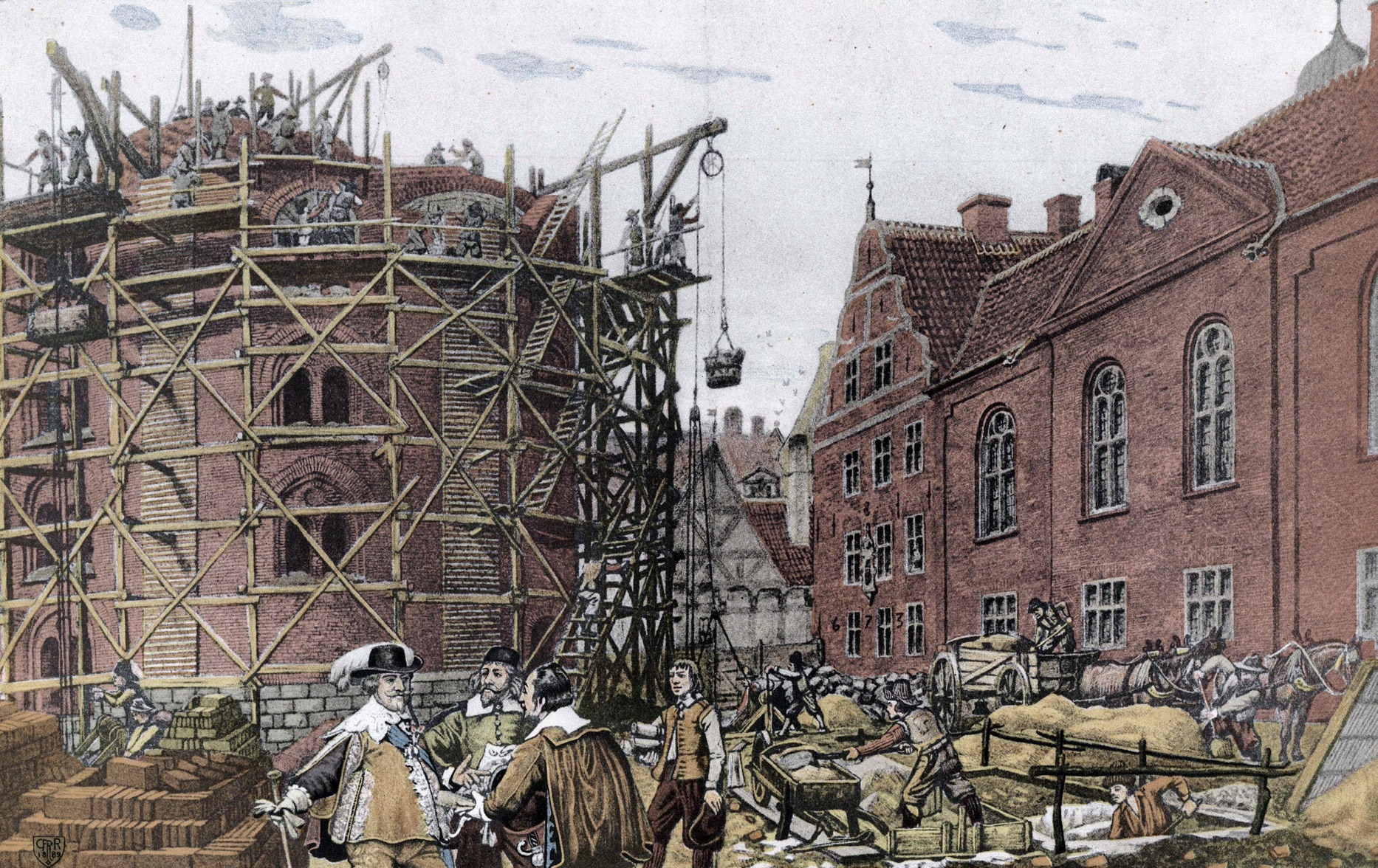
The Round Tower was built by Christian IV between 1637
and 1642. It was the first part of the Trinitatis
Complex, which combined church, library and observatory
in a single building.
The Tower once soared far above the rest of the rooftops
in the city, and University astronomers studied the
stars and planets from the Observatory at the top. The
scholars may have forsaken the building a long time ago,
but during the winter visitors are still able to gaze at
the cosmos from Europe's oldest functioning observatory.
The platform that runs around the outside of the
Observatory affords views over the old Latin Quarter –
from here, you can spot most of the city's famous
buildings.
Halfway up the tower is the entrance to the large and
stunningly beautiful Library Hall, which now serves as a
popular gallery and concert venue. It hosts several
exhibitions a year, and stages concerts almost every
week.
Above the Library is the Bell Loft,
notable for its enormous wooden beams, which were used
in the reconstruction of the Tower following the great
fire of Copenhagen in 1728. The Loft is also home to a
small exhibition of fascinating artefacts from the
Tower's history, including Christian IV's wax seal, a
tin of medicine produced by Tycho Brahe, and a piece of
the bomb that exploded in the Library Hall during the
bombardment of Copenhagen in 1807.
|
|
|
Unique Architecture
The Round Tower does not have an
elevator, so visitors have to climb the winding,
white-washed Spiral Walk, where kids often hide in the
niches, only to jump out shouting “boo!”
as adults approach.
The spiral walk is unique in European
architecture. The 209 m long spiral ramp winds itself
7,5 times round the hollow core of the tower, forming
the only connection between the individual parts of the
building complex.
|
 |
|
First big university
library in Denmark
The Library was once the home of the entire University
book collection. Situated halfway up the Round Tower,
the Library opened in 1657. It housed approximately
10,000 books, which had previously been spread around
old university buildings in the city.
At one end of the hall was an exhibition of Old Norse
artefacts, which would grow and become known as the
National Museum.
By 1861, the book collection had grown so big that it
was moved to the new premises on Fiolstræde.
The old Library was later used as a studio by
theatre-painter Carl Lund, and as a depot for the
Zoological Museum.
The Library was restored in 1987 and now serves as a
popular gallery and concert venue.
|
 |
|
Privy to the great and
good
The two original privies in the Round Tower still exist
– one on the top floor, the other beside the Library,
halfway up the tower. Although not in use, the Library
privy has been restored and re-opened. You may enter,
sit yourself down and gaze up at the arched ceiling,
where nicotine used to seep through the limestone in the
days when it was popular to smoke a pipe while visiting
the smallest room. We know that famous names such as
Ludvig Holberg, Ole Rømer, H.C. Ørsted and Hans
Christian Andersen studied in the Library, and probably
also needed to visit the privy now and again – with or
without a pipe.
Waste from the privy ran down into a large bricked-up
container (the latrine pit), but despite experiments
with open windows and double doors, the stench up in the
Tower was almost overpowering. Water closets were
installed in 1902 but the pit was not emptied until
1921, when nine truckloads of muck were shipped off.
|
 |
|
The Bell
Loft
Drying Loft and Peasant
Museum
The bells of the Church of the Trinity hang in the Bell
Loft, above the gallery and concert venue. However, the
bells do not take up much space in the 900-m² loft,
which has been rented out for all kinds of purposes over
the years. At one stage, the people of Copenhagen
discovered that it was an ideal spot in which to dry
laundry. Later, it was used to store tanned hides, dried
herbs, painted theatre sets and feathers for the fine
clothes and hats of society ladies.
In 1880, Lieutenant Bernhard Olsen rented the loft and
set up a peasant museum, which would become the Open Air
Museum in 1901.
After the Great Fire of 1728, the Bell Loft was rebuilt
from Pomeranian pine. The impressive original timbers
are still intact and visible in the loft, which also
houses the big clock from 1731, as well as many other
objects that have stories to tell about the history of
the Round Tower and the church.
|
 |
|
The Round Tower
Planetarium
The planetarium in the Round Tower is a
three-dimensional model of the Solar System with the Sun
at the centre, orbited by the six innermost planets.
Copied from Bayer's early-17th-century work, the
background depicts the starry sky of the North. It was
mounted in 1928 as a replacement for the original 1740
model.
The original planetarium showed both the Copernican
system, with the Earth orbiting around the Sun, and
Tycho Brahe's divergent system, with the Earth at its
centre.
The planetarium was not installed until 1697, but it was
built by Ole Rømer, astronomy professor and head of the
Round Tower observatory, as early as the 1670s.
|
 |
| Lead God
Uppermost on the facade of the tower
there is a gilded inscription, a rebus. Christian IV's
draft of it, written with his own hand, is kept at the
Danish Record Office. The rebus can be interpreted in
the following way: Lead God, the right teaching and
justice into the heart of the crowned King Christian IV,
1642. 1642 was the year when the tower was completed. |
|
| |
|
|
Oldest observatory in
Europe
Used by the University of Copenhagen until 1861, the
Round Tower is Europe's oldest functioning astronomy
observatory. It is now regularly used by amateur
astronomers and others who wish to explore the skies.
Astronomy was an important science in 17th-century
Europe, and Denmark's Tycho Brahe was one of its leading
figures. It was almost certainly due to Brahe's
influence that the Round Tower was built as a university
observatory in 1642. Unfortunately, he died in 1601, so
did not live to see it. His close colleague, astronomy
professor Longomontanus, was the first head of the new
stargazing tower
The Round Tower has contained several different
observatories. The latest is from 1929.
The observatory is 6.75 metres high and 6 metres in
diameter and contains a refracting telescope with
80–450 x magnification.
Opening hours
Read more of the history
of the Observatory
|
 |
|
Magnificent View From the
platform, 34.8 m above the street, the visitor has a
magnificent view of the old part of Copenhagen. Along
the edge of the platform runs a beautiful wrought-iron
lattice made in 1643 by Kaspar Fincke, Court Artist in
metalwork. In the latticework, Christian IV's monogram
and the letters RFP are seen; these letters represent
the King's motto: Regna Firmat Pietas - Piety
strengthens the Realms.
The view
|
 |
| . |
|
|
|
|
|