Refractions of Ice
-
20.09.2026


Refractions of Ice
What stories does the ice hold? In “Refractions of Ice”, art and ice core research melt together in a visual exploration of the deep ice and the climate memory of our planet.
“Refractions of Ice” is a visual investigation of deep ice in the Greenland Ice Sheet and Antarctica, created by Visual Science Studio in collaboration with researchers from Ice, Climate and Geophysics at the Niels Bohr Institute, University of Copenhagen. Through film, images, sound, and poetry, scientific research is transformed into a sensory experience that creates space for reflection on nature’s transformations and humanity’s role within them.
⭐⭐⭐⭐⭐
– KULTURINFORMATION
A Deep-Frozen Diary
The exhibition takes its point of departure in ice as a witness to the planet’s history: a frozen memory containing traces of the past. Ice in the great ice caps of Greenland and Antarctica preserves information about Earth’s climate changes over millennia. Each year’s snowfall captures and encapsulates countless details about our atmosphere and climate at the moment the snow forms. Year after year, new layers of snow are added, gradually compressed into ice, sinking deeper into the ice sheet and forming a several kilometer deep climate archive where geological time becomes visible in layers. No two years are alike, and each layer has its own unique story to tell: of gradual changes, but also of abrupt shifts.
“Ice cores from the great ice caps tell us, among other things, about the coming and going of ice ages, major volcanic eruptions, forest fires, and dust storms—and in more recent times, about human pollution and global warming,” says ice core researcher Anders Svensson, part of the research team from the Niels Bohr Institute.
Light as Method
This exhibition is part of the LIGHT YEAR 2026 program at the Round Tower. A full year of experiences marking the 350th anniversary of Ole Rømer’s groundbreaking discovery of the speed of light.
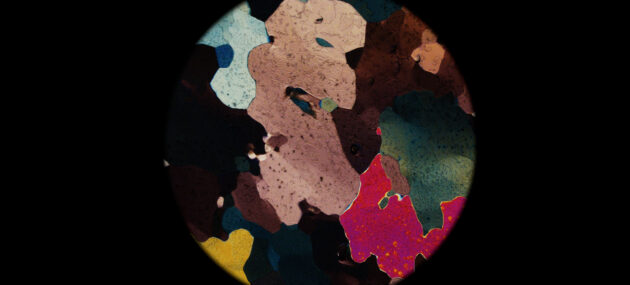
Light is a central element in both the exhibition and parts of the research behind it: using polarized light from laboratory lamps, the crystal structures of ice emerge in colors and patterns that reveal new details and insights into the state and movement of ice.
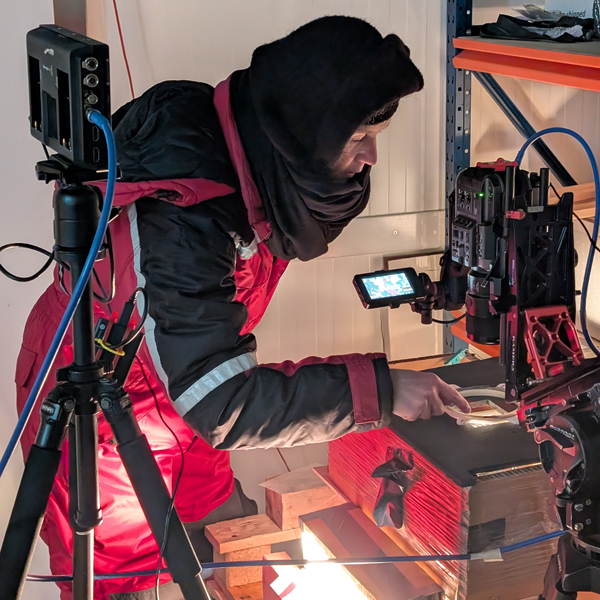
“Together with the researchers, we have spent days in a large freezer filming ice up to two million years old as it dissolves. Within the microscopic crystal structures lie traces of planetary movements and shifts. But ice is not just a material that is disappearing—it is also the planet’s memory. A visual warning of the imbalances underway, and a testimony to a world we will not get back,” says artist Maja Friis from Visual Science Studio.
Experience “Refractions of Ice” from June 26th to September 20th in the Library Hall at Rundetaarn, accompanied by a series of events with researchers, artists, and journalists.
Visual Science Studio communicates science in an immersive and sensory way. Through installations, films, and talks, they transform intangible data into tangible experiences, enabling people to connect emotionally with research and climate change through aesthetics.
Supported by:
- Knud Højgaard Foundation
- William Demant Foundation
- Aage og Johanne Louis-Hansens Fond
- Novo Nordisk Foundation
- Augustinus Foundation
Please note that the exhibition cannot be experienced at times when the Library Hall is temporarily closed due to events or during the construction of changing special exhibitions. Check our landing page rundetaarn.dk before your visit, where current closures will be listed at the top of the page.