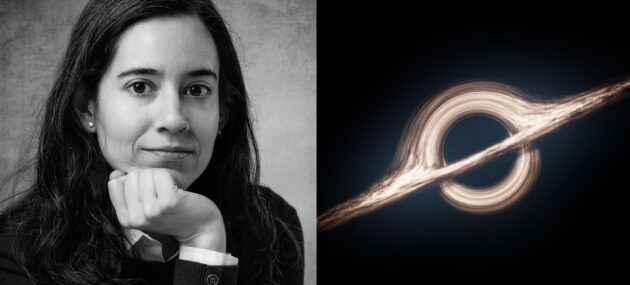
Black Holes: When Light Falls In


Black Holes: When Light Falls In
Join physicist Lorena Magaña Zertuche on a journey into the fascinating world of black holes and discover how scientists use gravitational waves, light, and gravity itself to explore the most extreme phenomena in the universe. This talk will be in English.
For centuries, astronomy has been the study of light. Almost everything we know about the universe has come from capturing the faint glow of distant stars and galaxies. But now black holes have given us a new window into the Cosmos. Black holes are so massive that they trap even light itself but despite this black holes are becoming some of our most powerful tools for probing the universe.
When two black holes collide, they cretae ripples in the fabric of space and time known as gravitational waves which carry a record of some of the most violent events in the universe. Thanks to observatories like LIGO, scientists have learned how to “listen” to these waves for the first time, opening a completely new chapter in astronomy. In the future, the space-based observatory LISA will take us even further, allowing us to explore giant black hole mergers across the universe.
In this talk, physicist Lorena Magaña Zertuche will take you on a journey into the strange and fascinating world of black holes where gravity itself becomes a messenger. She will reveal how scientists use black holes to test Einstein’s theory of gravity, search for signs of new physics and uncover the clues to understanding how our cosmos works.
Meet Lorena Magaña Zertuche
Lorena Magaña Zertuche is a theoretical physicist at the new Center of Gravity research centre at the Niels Bohr Institute where researchers are working on some of the biggest questions in modern physics: What happens inside a black hole? How are gravity and quantum mechanics connected? And what can gravitational waves tell us about the history and evolution of the universe?
Lorena combines theoretical physics, advanced computer simulations, and artificial intelligence to understand the most extreme environments in the universe — using black holes as laboratories to explore the fundamental nature of gravity.
The event is part of Black Hole Week, organised by the Center of Gravity, a new Centre of Excellence at the Niels Bohr Institute dedicated to exploring gravity, black holes, and the most extreme phenomena in the universe.
Experience the exhibitions and the Round Tower
Before and after the evening’s talks, guests will also have the opportunity to explore the exhibitions Refractions of Ice and Ole Rømer and the Great Discovery, Rundetaarn’s introductory exhibition. Visitors are also welcome to walk up the beautiful Spiral Ramp to the top of the Tower and enjoy the panoramic views over Copenhagen. Wine and non-alcoholic refreshments will be available for purchase during the event.
The talk is part of Rundetaarn’s LIGHT YEAR 2026 programme, marking the 350th anniversary of Ole Rømer’s discovery of the speed of light.